
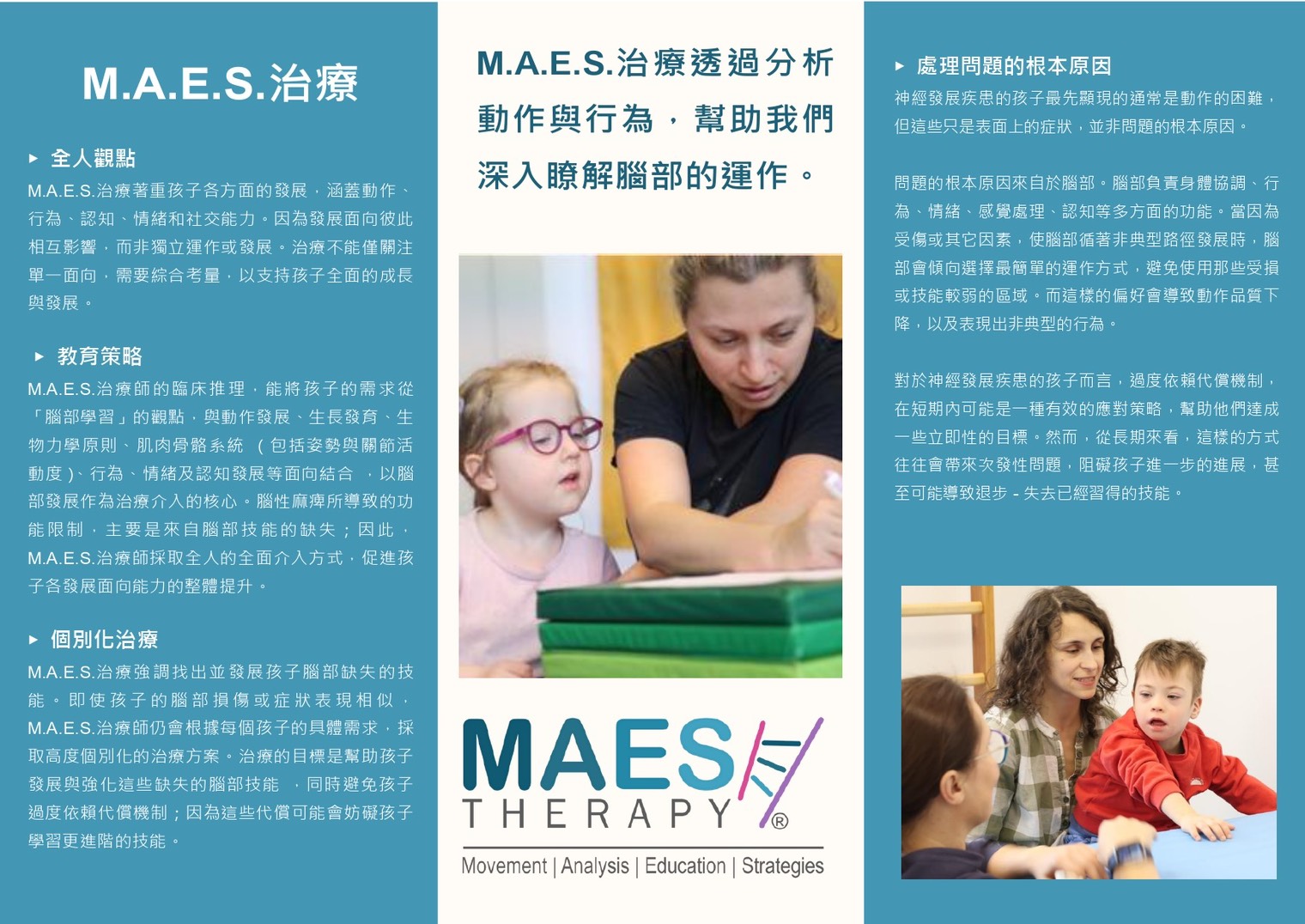
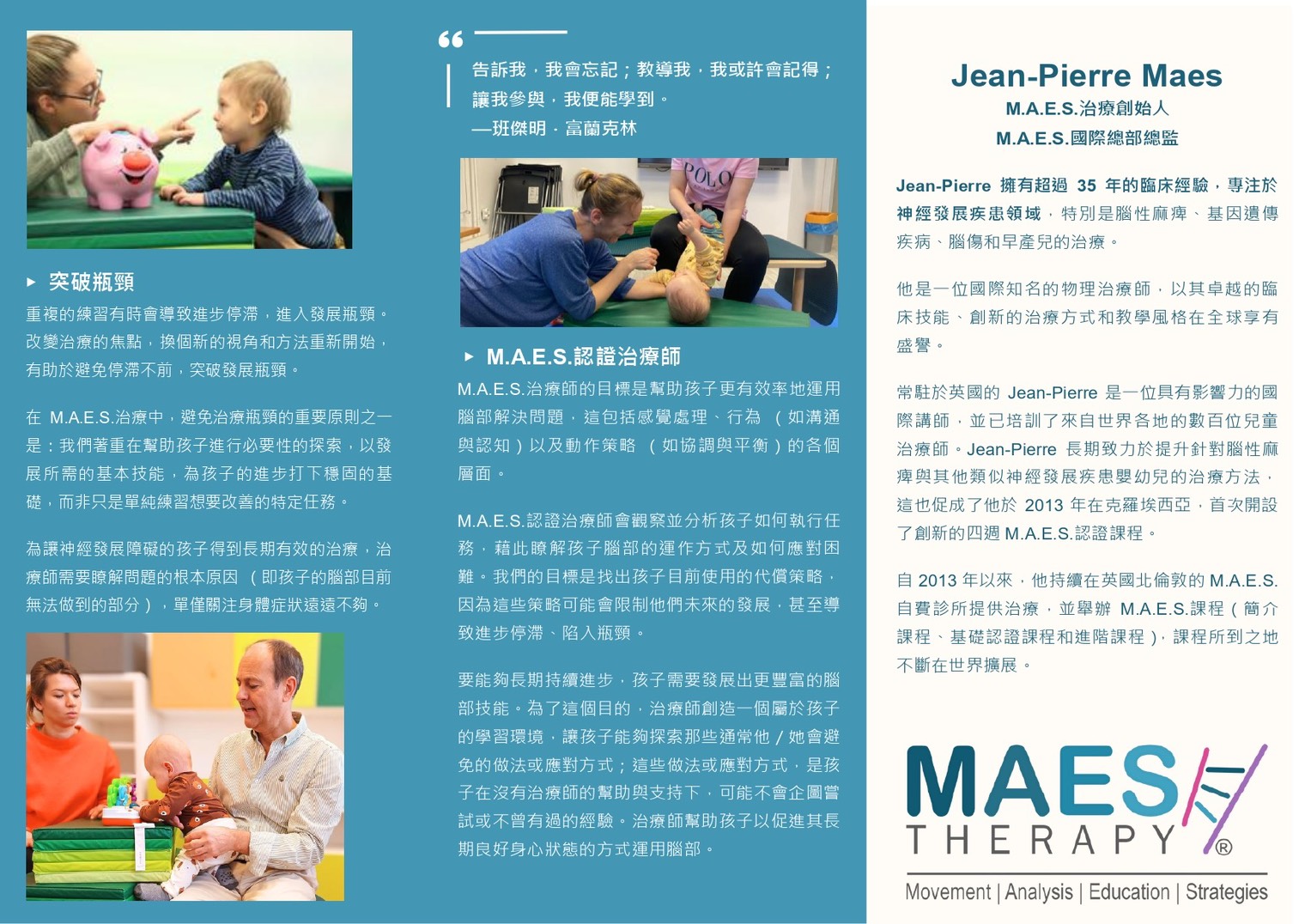
Image source: Provided by Taiwan MAES
In the field of early developmental therapy for children, when parents bring their child to a therapy center, the most common expectations are usually: "Therapist, when will he walk?" or "Can you help him sit up steadily soon?" While "achieving specific functional milestones (sitting, standing, walking)" is indeed an important goal in early developmental therapy, for children with brain neurodevelopmental disorders, simply repeating movements sometimes does not allow the brain to truly learn flexible application. MAES Therapy offers a different perspective: it doesn't just look at whether a child "can complete a movement," but analyzes "what strategy the brain uses to complete the movement."
Today, Compass Physiotherapy is introducing an inspiring, internationally recognized therapy—MAES (Movement Analysis & Education Strategies). It leads us to step beyond the "muscle strength training" mindset and delve deep into the child's brain neurology, re-understanding how they "perceive and control their own bodies."
What is MAES Therapy? Shifting from "Training Movements" to "Analyzing Strategies"
MAES Therapy was founded by senior pediatric physical therapy expert Jean-Pierre Maes. With over 30 years of rich experience treating children with cerebral palsy and neurodevelopmental disorders, he discovered that many children with neurological damage eventually "learn" a skill, but their movements are very stiff, energy-consuming, and accompanied by severe abnormal muscle tone. Why is this so?
From the MAES perspective, this originates from a brain issue because their brain's built-in "database" is too small. When a typically developing child reaches for a toy, their brain can instantly calculate various postural and muscle combinations to achieve the task (this is called a strategy). But for a child with neurological abnormalities, their brain might only have "one" single solution: for example, instantly tensing the whole body and forcefully extending the arm (this is called single compensation). If the child is allowed to repeat this behavior, their brain will reinforce this single method, making it increasingly dominant, leading to higher muscle tone and increasingly rigid movements or behaviors.
Therefore, MAES first analyzes the child's brain's "functions and strategies" and guides the brain to find alternative pathways.
MAES Therapy Concepts - Every Child is Unique
- Analysis: The therapist's eyes are like an X-ray machine. We don't just look at the child's "movements"; we analyze the child's behavior, learning strategies, and how the brain operates. Observing all aspects to find the brain's "blind spots" is the first step in treatment.
- Reducing Compensation: When a child is used to doing things with high muscle tone (e.g., scissoring gait, whole-body stiffness), the therapist will analyze and change these shortcuts the child overly relies on. We want the brain to know: "You don't need to tense your whole body to do things; please relax and experience different sensations."
- Building Repertoire: We do not force the child to perform a specific standard movement. Instead, we provide the brain with different spatial, temporal, and sensory contexts to help the child "organize and develop" different pathways and methods. The same problem can have different solving strategies and multiple solutions.
- Good Quality Lays the Foundation: The body is the brain's tool. Lowering task complexity and increasing the child's motivation allows inner drive to achieve more. Poor quality will prevent the child from progressing to the next milestone.
What Kind of Children is MAES Therapy Suitable For?
The application of MAES Therapy is very broad and is not limited to children; it can also be used on adults. In the clinical practice at Compass Physiotherapy, we recommend that the following children undergo MAES assessment:
- Cerebral Palsy (CP): Especially for children who exhibit severe high-tone stiffness upon excitement or have fluctuating and unstable muscle tone. MAES can deeply deconstruct their complex network of tone compensation and guide the child to do things with better quality.
- Developmental Coordination Disorder (DCD): Although the child can perform movements, they appear uncoordinated and fall often. MAES focuses on encouraging the child to develop missing "brain skills" and guiding them to discard ineffective or rigid compensatory movements. MAES can help them build more refined and diverse movement fine-tuning strategies.
- Severe Delays Caused by Chromosomal and Rare Neurological Diseases: MAES is not limited to specific diagnostic labels. As long as the child's motor development shows "atypical" or "stuck" patterns, deep intervention can be carried out through the MAES framework.
Common Parent FAQs
Q1: With MAES Therapy, will my child's progress be slower? Others are already practicing standing!
This is indeed a doubt for many parents. The focus of MAES Therapy is to first stabilize the "foundation of quality" rather than quickly achieving the appearance of a milestone. When a child's brain has not yet established a sufficient foundation and is propped up in a specific posture through compensation, they may quickly hit a bottleneck in the long run.
What we hope for is an improvement in "Movement Quality and Adaptability." We are willing to spend time helping the child lay a stable foundation, allowing their brain to learn to control the body with relaxed, appropriate muscle, movement, and sensory combinations. In the short term, the progress of motor "milestones" may seem slow, but because we have built a solid and diverse neurological foundation, in the long run, the child will have greater potential for expansion.
Q2: Why is it necessary to maintain a very simple and quiet environment during MAES treatment?
- Reduce Cognitive Load: Children with neurodevelopmental delays or cerebral palsy have a weaker ability to process multiple sensory inputs (such as loud noises or bright backgrounds). A simple environment allows the child to focus on the therapist's guidance.
- Avoid Brain Compensation: The treatment focuses on guiding the child to use the correct brain circuits to learn movements. If the environment is too complex, the child may easily rely on past habitual incorrect postures or "shortcuts" to complete tasks, which hinders neurological development.
- Promote Active Exploration: A quiet atmosphere helps reduce interference from abnormal muscle tone or emotional fluctuations, allowing the therapist to use precise hands-on guidance to help the child understand body movements, thereby spontaneously expressing needs and exploring.
By having you observe from the sidelines, we hope to teach you the perspective to "understand the meaning behind the child's subtle movements." Once you learn to analyze: "Oh! He is currently using abnormal muscle tone in his back for this compensation," you can unconsciously provide the correct guiding environment during daily feeding, playing, bathing, or any other moment, preventing incorrect compensations from occurring. This is the truly highly effective principle of integrating developmental therapy into daily life.
(In the face of the mysteries of brain neurology, every child is a unique problem-solver. MAES Therapy does not apply the same formula to different children. If you feel your child's treatment has hit a bottleneck, or if you wish to find a easier, more inspiring path for your child's motor development, welcome to Compass Physiotherapy, and let us unlock your child's exclusive movement code together.)
References
- Novak I, Morgan C, Adde L, et al. (2017). Early, Accurate Diagnosis and Early Intervention in Cerebral Palsy: Advances in Diagnosis and Treatment. JAMA Pediatrics, 171(9), 897–907.
- Damiano DL, Longo E. (2021). Early intervention evidence for infants with or at risk for cerebral palsy: an overview of systematic reviews. Developmental Medicine & Child Neurology, 63(7), 771–784.
- Kwong AKL, Fitzgerald TL, Doyle LW, Cheong JLY, Spittle AJ. (2018). Predictive validity of spontaneous early infant movement for later cerebral palsy: a systematic review. Developmental Medicine & Child Neurology, 60(5), 480–489.