




Scaffolding is commonly used in child development, education, and therapy.
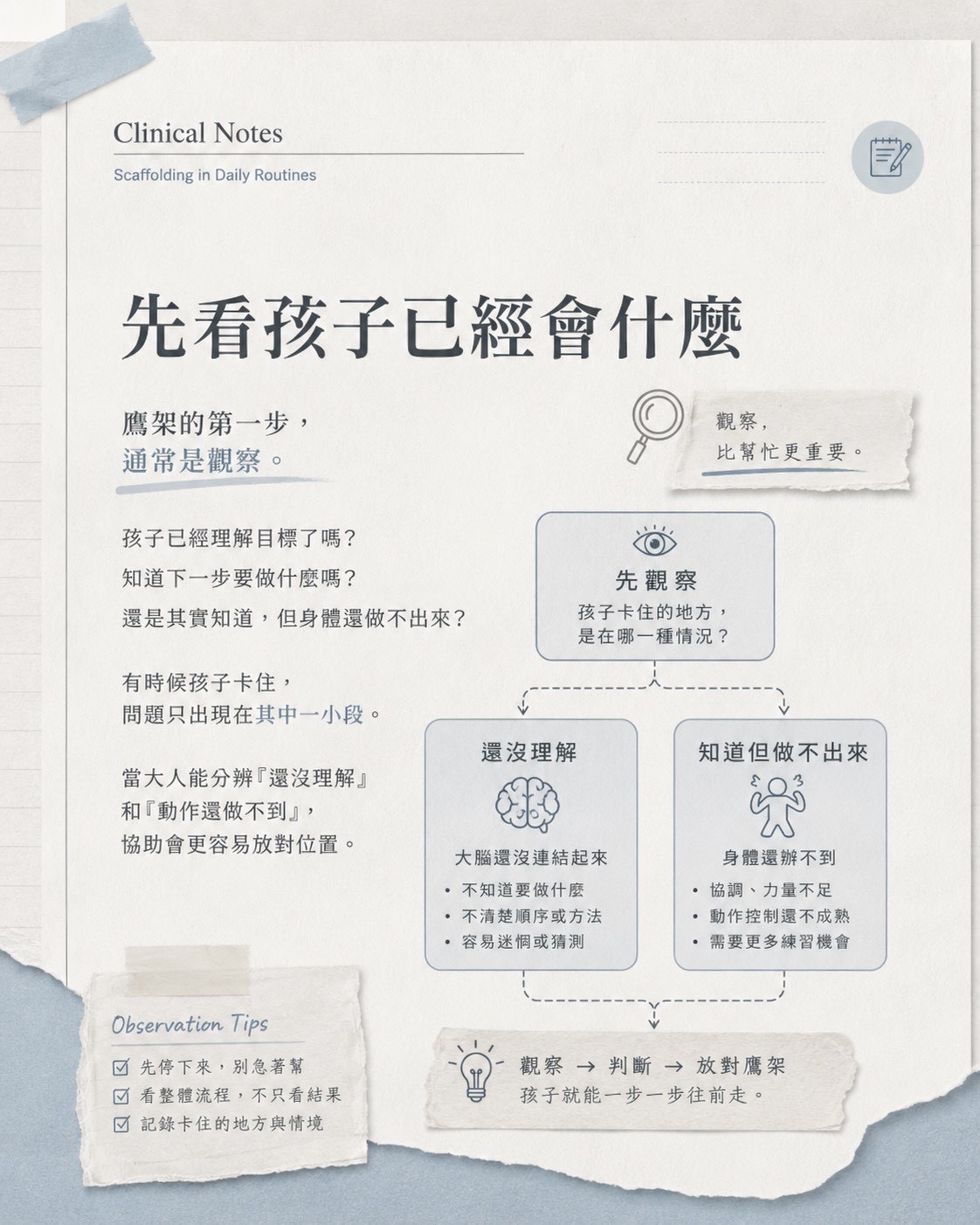
Its core concept is actually quite simple: first observe what the child can already do, then provide assistance exactly where they need it.
Some children need more prompts, while others only need a little bit of support. An adult's assistance adjusts to the child's current abilities.
Failure Does Not Mean the Entire Task Is Difficult
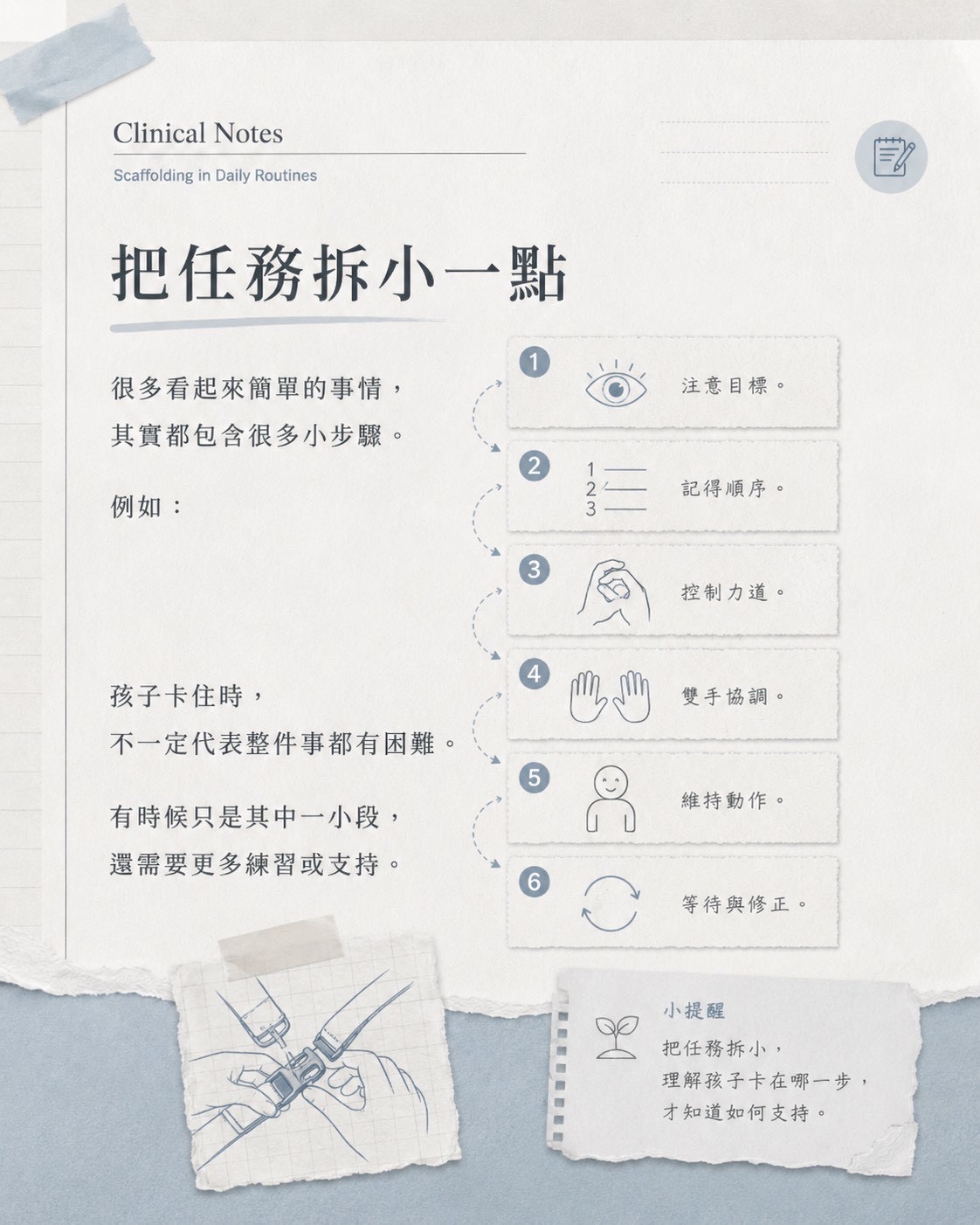
Clinically, I often observe one thing: when a child fails, it does not necessarily mean the entire task is difficult for them.
Sometimes they know the goal, know the process, and even know what the next step is. It is just that a specific small part cannot be connected yet:
- It might be that their motor control is not yet stable
- It might be that their bilateral coordination is not yet mature
- It might be that their attention dropped quickly
- Or they might just need a little more time to organize their body
Observation Is the Foundation of Scaffolding
Therefore, what is truly important about scaffolding, besides teaching, includes observation.
- Observing where the child is currently stuck
- Observing which parts they can already complete independently
- Observing whether the adult's assistance is too much or too little
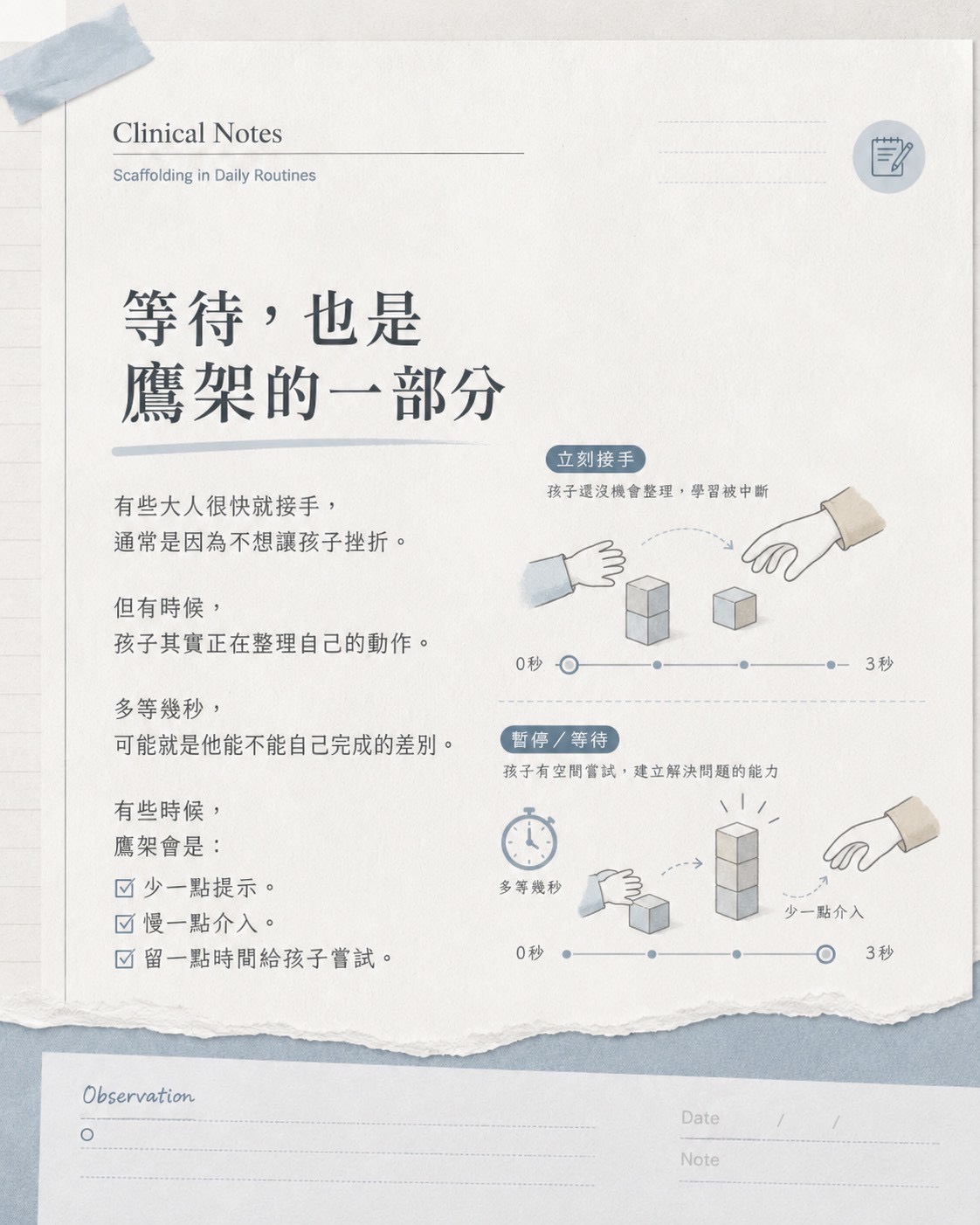
Often, good scaffolding is actually quite minimal:
- A short reminder
- A visual prompt
- A physical demonstration
- A hand helping to stabilize an object
- Or even just waiting a few extra seconds
Scaffolding Gradually Fades Out
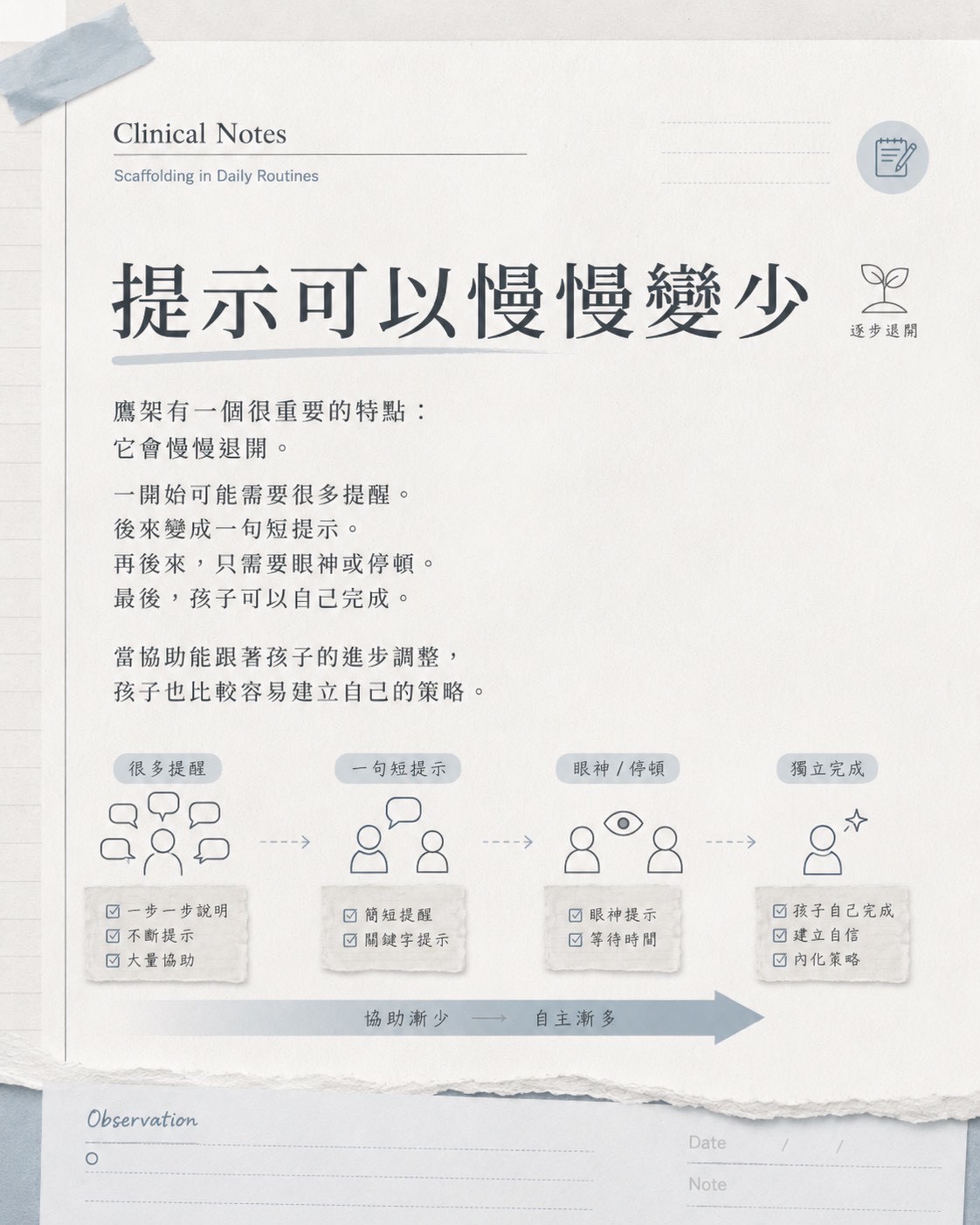
Moreover, scaffolding has a very important feature: it gradually fades out.
As the child becomes more familiar, prompts decrease, assistance lightens, and waiting periods lengthen. Finally, the child gets the opportunity to truly retain the skills within themselves.
Sometimes we rush to help complete the task. But in development, what is often more noteworthy is: whether the child participated, whether they tried, and whether they gradually built their own methods.
The purpose of scaffolding is to accompany the child step by step toward greater independence.
Reference Concepts
- Vygotsky, L. S. (1978). Concept of the Zone of Proximal Development (ZPD).
- Wood, D., Bruner, J. S., & Ross, G. (1976). The role of tutoring in problem solving. Journal of Child Psychology and Psychiatry, 17(2), 89–100.